Friday, June 30, 2006
Strange new respect
I regulary disagree with Bill Christofferson, but yesterday I learned that he is a friend of Marcia Ball who is apparently married to one of his army buddies. The Reddess and I think Marcia Ball is great. Maybe he's not all bad.


The atmospherics on Hamdan
Yesterday on "MCS, one of my co-panelist, Jim Rowen, tried to get me to admit that the Hamdan decision means that Bush broke the law. On the way home this afternoon (I left early - sue me), I heard more of this on the same station. "Rick Esenberg was beside himself yesterday" apparently because Bush "broke the law."
There is, of course, a sense in which this is true. A majority of Justices - and, therefore, the Court - held that the type of military trial being held in Hamdan's case violated the Uniform Code of Military Justice and, perhaps, the common articles of the Geneva Convention.
But the phrase is also misleading in that when we use the term "lawbreakers," we generally mean someone who willfully ignores a clear legal command. We don't generally use that term to refer to a public position who takes a reasonable legal position with respect to his or her authority that is ultimately overruled by the courts. If we did, every President we have ever had - certainly everyone in the modern era of judicial review - would be a "lawbreaker" because everyone of them has lost cases in courts. Clinton, for example, argued that Hillary's healthcare task force could operate in secrecy. The courts said it could not. Is it fair to say he broke the law? Yes in one sense, but not quite in the way that we use that term in everyday life. Clinton also lost a case in which the Court held that a racial set-aside program amounted to unconstitutional discrimination and a host of others.
How do we know that Bush's position was reasonable? Without even getting into the merits, we know that the D.C. Circuit agreed with him. In Hamdan itself, three Justices agreed with him (and Roberts would have since he already ruled on the question while on the D.C. Circuit). All of the opinions in Hamdan occupy 185 pages in PDF format. To say that Bush was obviously wrong and willfully broke the law is ... obviously wrong.
There is, of course, a sense in which this is true. A majority of Justices - and, therefore, the Court - held that the type of military trial being held in Hamdan's case violated the Uniform Code of Military Justice and, perhaps, the common articles of the Geneva Convention.
But the phrase is also misleading in that when we use the term "lawbreakers," we generally mean someone who willfully ignores a clear legal command. We don't generally use that term to refer to a public position who takes a reasonable legal position with respect to his or her authority that is ultimately overruled by the courts. If we did, every President we have ever had - certainly everyone in the modern era of judicial review - would be a "lawbreaker" because everyone of them has lost cases in courts. Clinton, for example, argued that Hillary's healthcare task force could operate in secrecy. The courts said it could not. Is it fair to say he broke the law? Yes in one sense, but not quite in the way that we use that term in everyday life. Clinton also lost a case in which the Court held that a racial set-aside program amounted to unconstitutional discrimination and a host of others.
How do we know that Bush's position was reasonable? Without even getting into the merits, we know that the D.C. Circuit agreed with him. In Hamdan itself, three Justices agreed with him (and Roberts would have since he already ruled on the question while on the D.C. Circuit). All of the opinions in Hamdan occupy 185 pages in PDF format. To say that Bush was obviously wrong and willfully broke the law is ... obviously wrong.
Tell him he can come pick it up
Osama bin Laden wants al-Zarqawi's body released. I say that we grant his request.
Thursday, June 29, 2006
Shark and Shepherd on the Air
It's a beautiful day. Leave work early and listen to me bloviate on WMCS-1290 from 4:30 to 6.
Blast from the recent past
Hippie (would he accept that description?)blogger Tim Rock at The Other Side of My Mouth commented over two weeks ago on an exchange involving Jay Bullock, Patrick McIlheran and me on the extent to which disapproval (or, more accurately, the absence of a ringing endorsement) of homosexuality can be equated with bigotry.
Two weeks ago on the net is the Pleistocene era, but I have been busy and just saw this.
Mr. Rock has said very nice things about my blog (with which he apparently mostly disagrees), so he is obviously a fellow of refined taste and intelligence. Also what he says in response to my post is fair-minded. I bring it up only to correct a few things, if only to caution against assuming too much about what goes with a given set of views - a mistake that I make as much as the next guy.
1. Tim characterizes what I wrote as the view that homosexuals are not as good as heterosexuals. That is not right. As a Christian (I can't speak for other faiths), I don't believe that anyone is not as good as (or is better than) anyone else. I am open to the notion that homosexuality is not as full an exploration of God's gift of sexuality as heterosexuality, but I'm willing to listen on that. Believing such a thing (as Tim correctly recognizes) does not amount to bigotry or hatred.
2. Tim assumes I am Roman Catholic. It'd be fine if I were, but I'm not. I used to be, but I was received into the Episcopal Church in 2001. We're the ones with the gay bishops. We're the ones for whom gayness has become a 24/7 concern.
3. Tim assumes that my friends think the way I do. Some do. But lots don't; particularly, I suspect, the ones who are gay Episcopalians. I doubt that they are open to the notion in paragraph 1, but you never know. I haven't asked and am not likely to.
NB: Mr. Rock is apparently my exactly my age and is having another kid? He is a better man than I am. When I want new little Esenbergs, I let my son and daughter-in-law have them.
Two weeks ago on the net is the Pleistocene era, but I have been busy and just saw this.
Mr. Rock has said very nice things about my blog (with which he apparently mostly disagrees), so he is obviously a fellow of refined taste and intelligence. Also what he says in response to my post is fair-minded. I bring it up only to correct a few things, if only to caution against assuming too much about what goes with a given set of views - a mistake that I make as much as the next guy.
1. Tim characterizes what I wrote as the view that homosexuals are not as good as heterosexuals. That is not right. As a Christian (I can't speak for other faiths), I don't believe that anyone is not as good as (or is better than) anyone else. I am open to the notion that homosexuality is not as full an exploration of God's gift of sexuality as heterosexuality, but I'm willing to listen on that. Believing such a thing (as Tim correctly recognizes) does not amount to bigotry or hatred.
2. Tim assumes I am Roman Catholic. It'd be fine if I were, but I'm not. I used to be, but I was received into the Episcopal Church in 2001. We're the ones with the gay bishops. We're the ones for whom gayness has become a 24/7 concern.
3. Tim assumes that my friends think the way I do. Some do. But lots don't; particularly, I suspect, the ones who are gay Episcopalians. I doubt that they are open to the notion in paragraph 1, but you never know. I haven't asked and am not likely to.
NB: Mr. Rock is apparently my exactly my age and is having another kid? He is a better man than I am. When I want new little Esenbergs, I let my son and daughter-in-law have them.
Reading Hamdan in Milwaukee
The Hamdan decison is 185 pages long and I haven't read it all. But I think that it may be less signficant with respect to the trial of the GiTMO detainees than it may be on other issues. The case does not appear to hold that detainees are subject to all the rights to which criminal defendants are entitled, only that they are entitled to more rights than the military commissions actually established provide. Hamdan, for example, was excluded from his own trial.
But a majority of the Court seems to have ruled that certain provisions of the Geneva Convention, i.e., the "common" articles, do apply to the war against al Qaeda. The D.C. Circuit had held that these provisons only apply to wars between nations. As you can read here, this may have implications for the form of permitted interrogation.
But a majority of the Court seems to have ruled that certain provisions of the Geneva Convention, i.e., the "common" articles, do apply to the war against al Qaeda. The D.C. Circuit had held that these provisons only apply to wars between nations. As you can read here, this may have implications for the form of permitted interrogation.
Silliness on soccer
Sean Hackbarth at The American Mind doesn't like soccer. That is fine. But during the World Cup, lots of people who don't like soccer are working overtime to explain why most of us are indifferent to a game that the rest of the world goes nuts over.
Sean links to a thumbsucker at the Weekly Standard's website written by Frank Cannon and Richard Lessner. They argue that soccer is popular elsewhere because the rest of the world is gripped in a postmodern nihilism. There is not, in the view of the authors, much scoring in soccer, so it must be a game about nothing. They go on to say that the sport is contrary to nature because you can't use your hands and, ironically echoing hand wringing soccer moms, you risk brain injury by heading the ball. Soccer, they conclude, is just not natural.
This is silliness on steroids. First, the presuppositions are all wrong. Anyone who thinks American football (always my favorite sport) is natural or in any way consistent with good care of the body has never played a down. While most of Europe (but not all) is distessingly postmodern, soccer is also wildly popular in the religious global South.
Second, the connections are all wrong. The fact that a goal is hard to score doesn't make it meaningless. To the contrary, it magnifies its worth. Although the authors think that the absence of scoring means that you can walk away for huge chunks of time, it actually means that you can never avert your eyes because you might miss it. That fact that soccer players may not use their hands (the "natural" thing) makes it all the more fascinating. This is set of skills that most of us can't even fantasize about.
David Post, blogging at the Volokh Conspiracy, demonstrates that soccer, contrary to being about nihilism and disaffection, is about resolve and perserverance. It's about character.
When I first discovered soccer, I, too, came up with lots of great ideas for how to get more scoring. Widen the penalty box -- make the net bigger -- etc. etc. But then it hit me. Soccer is the great team sport because it is a test of team will, and it is a test of team will precisely because it is so damned hard to score a f**king goal. You have to run down that field, time and time and time and time again, knowing full well that there's "practically no chance" anything will come of it. Again and again and again. You might have to do it for ninety minutes and get nothing, and then you have to do it again in the next game. It is exhausting, physically and, even more, mentally. But you have to keep doing it, because the moment you stop doing it -- the moment anyone on the team starts to think about not doing it -- you lose.
Character and belief and determination and will become very, very transparent in these circumstances, and soccer, more than any other sport I know of, is about these things. Scoring is incredibly difficult -- but if you let yourself believe that you can't score, you will not score. It's why you'll see soccer fans sometimes giving their team a standing ovation after a 0-0 draw -- because character and determination and belief are very transparent, and can be detected even when no goals have been scored (perhaps best, actually, when no goals have been scored).
Take that.
Sean also links to Betsy Newark who likes Jonathan Laster's (also writing at the Daily Standard)theory that the problem is the "flop and bawl." Soccer players go down in an effort to draw fouls and penalties. Laster thinks that, in American sports, we have "floppers" but no one likes them. Please. Show me an incomplete pass in the NFL where the receiver isn't flipping his wrist and waving his arms in search of a flag. Show me a charge in the NBA (or NCAA) where the defender doesn't hurl himself backwards as if he were hit by a freight train, rather than a little point guard.
But, Laster says, the problem is that players also pretend - very briefly - to be injured. Sometimes, that's true. There is a reason for that. Contrary to the conceit of many (including, again, soccer moms) that soccer is a "kinder and gentler" sport, it's actually very rough. You need to fake - or display - an injury because, unless you are hurt, you are unlikely to get a call - at least unlikely to get the yellow or red card that will really matter. What would be interference in football or hacking in basketball is business as usual on the pitch.
Laster says that we Americans like it when people play hurt. We appreciate the courage and the effort. But my guess is that people in other countries do too. In fact, like all the others, he has the potential distinctions backwards. There is a reason those writhing players get up so quickly. The rules of soccer actually dictate that you play hurt in a way the the rules of basketball and football don't.
An injured player can't leave the game and come back. If you are going to shake it off, you better do it quickly because your side will be a man down until you get your butt back out there. Thus, in the US-Italy game, when the US' Brian McBride got his face split open by an Italian elbow, he had to get it patched together as quickly as possible because no one was permitted to replace him until he was to return to the game. He was back real fast.
It's simple. Most of us don't like soccer because it was not invented here. It's ok to admit that and ok to feel that way. There is no need to dream up self serving explanations
Sean links to a thumbsucker at the Weekly Standard's website written by Frank Cannon and Richard Lessner. They argue that soccer is popular elsewhere because the rest of the world is gripped in a postmodern nihilism. There is not, in the view of the authors, much scoring in soccer, so it must be a game about nothing. They go on to say that the sport is contrary to nature because you can't use your hands and, ironically echoing hand wringing soccer moms, you risk brain injury by heading the ball. Soccer, they conclude, is just not natural.
This is silliness on steroids. First, the presuppositions are all wrong. Anyone who thinks American football (always my favorite sport) is natural or in any way consistent with good care of the body has never played a down. While most of Europe (but not all) is distessingly postmodern, soccer is also wildly popular in the religious global South.
Second, the connections are all wrong. The fact that a goal is hard to score doesn't make it meaningless. To the contrary, it magnifies its worth. Although the authors think that the absence of scoring means that you can walk away for huge chunks of time, it actually means that you can never avert your eyes because you might miss it. That fact that soccer players may not use their hands (the "natural" thing) makes it all the more fascinating. This is set of skills that most of us can't even fantasize about.
David Post, blogging at the Volokh Conspiracy, demonstrates that soccer, contrary to being about nihilism and disaffection, is about resolve and perserverance. It's about character.
When I first discovered soccer, I, too, came up with lots of great ideas for how to get more scoring. Widen the penalty box -- make the net bigger -- etc. etc. But then it hit me. Soccer is the great team sport because it is a test of team will, and it is a test of team will precisely because it is so damned hard to score a f**king goal. You have to run down that field, time and time and time and time again, knowing full well that there's "practically no chance" anything will come of it. Again and again and again. You might have to do it for ninety minutes and get nothing, and then you have to do it again in the next game. It is exhausting, physically and, even more, mentally. But you have to keep doing it, because the moment you stop doing it -- the moment anyone on the team starts to think about not doing it -- you lose.
Character and belief and determination and will become very, very transparent in these circumstances, and soccer, more than any other sport I know of, is about these things. Scoring is incredibly difficult -- but if you let yourself believe that you can't score, you will not score. It's why you'll see soccer fans sometimes giving their team a standing ovation after a 0-0 draw -- because character and determination and belief are very transparent, and can be detected even when no goals have been scored (perhaps best, actually, when no goals have been scored).
Take that.
Sean also links to Betsy Newark who likes Jonathan Laster's (also writing at the Daily Standard)theory that the problem is the "flop and bawl." Soccer players go down in an effort to draw fouls and penalties. Laster thinks that, in American sports, we have "floppers" but no one likes them. Please. Show me an incomplete pass in the NFL where the receiver isn't flipping his wrist and waving his arms in search of a flag. Show me a charge in the NBA (or NCAA) where the defender doesn't hurl himself backwards as if he were hit by a freight train, rather than a little point guard.
But, Laster says, the problem is that players also pretend - very briefly - to be injured. Sometimes, that's true. There is a reason for that. Contrary to the conceit of many (including, again, soccer moms) that soccer is a "kinder and gentler" sport, it's actually very rough. You need to fake - or display - an injury because, unless you are hurt, you are unlikely to get a call - at least unlikely to get the yellow or red card that will really matter. What would be interference in football or hacking in basketball is business as usual on the pitch.
Laster says that we Americans like it when people play hurt. We appreciate the courage and the effort. But my guess is that people in other countries do too. In fact, like all the others, he has the potential distinctions backwards. There is a reason those writhing players get up so quickly. The rules of soccer actually dictate that you play hurt in a way the the rules of basketball and football don't.
An injured player can't leave the game and come back. If you are going to shake it off, you better do it quickly because your side will be a man down until you get your butt back out there. Thus, in the US-Italy game, when the US' Brian McBride got his face split open by an Italian elbow, he had to get it patched together as quickly as possible because no one was permitted to replace him until he was to return to the game. He was back real fast.
It's simple. Most of us don't like soccer because it was not invented here. It's ok to admit that and ok to feel that way. There is no need to dream up self serving explanations
Little more than detox


Susan Sarandon, Sean Penn, Cindy Sheehan and Dick Gregory (so what else is new?) are going on a hunger strike to bring the troops home. In a press release, the groups says that they will "be showing our patriotism by putting our bodies on the line to bring our troops home."
But in typical West Coast fashion, those famous bodies are just going to stick a toe on that line and then beat it to Spago for an eight o'clock table. It is a rolling hunger strike. You just go on the Hollywood diet for 24 hours (a mere half shift) and pass it to someone else. No hushed nation need anxiously wait to see if Susan and Spicoli make it.

What I am wondering is why this guy's not on board.

Wednesday, June 28, 2006
Hamsterdam at Miller Park

The Reddess and I are huge fans of The Wire on HBO, a drama about cops and the drug trade in the inner city of Baltimore. The man on the right is Robert Wisdom who plays Major Howard "Bunny" Colvin, commander, of Baltimore's western district. In the third season of the show (now in reruns on Sunday nights at 7), he gives a little speech about the paper bag being a wonderful instrument of civic compromise. "The corner," he says, "has always been the poor man's lounge." Putting his fifth into a paper bag allowed him to drink on the streets and permitted the police to look the other way.
In the spirit of the paper bag, Colvin decides to direct all drug traffic in his distruct to an abandoned block of boarded up rowhouses. As long as it stayed on that block, drugs were legal "in the western." The gangs, mishearing Colvin's explanation of the new policy, refer to the "free zone" as "Hamsterdam."
Mike McGee, Jr., wants, in a sense, to bring Hamsterdam to Milwaukee. But rather than establish it in a part of town in which no one lives or for which there is no use, he proposes turning Miller Park into one big overnight tailgate party. He wants to let people cruise there.
There are two ways in which this would work (or, more accurately, not work). In the first scenario, the County, in order to prevent drinking, drugs, vandalism and violence, would have to maintain a presence of sheriff deputies so massive that no respectable cruiser would go there. In the second, Miller Park gets turns into a scene out of Escape from New York.
Tuesday, June 27, 2006
Is Doyle at the precipice?
I wonder. As I (here and in the paper)- and oh so many others have noted - the Doylies spin on the Thompson verdict is amazingly lame. One would have thought that the Governor would have promised to fully investigate whether any of his subordinates had pressured Ms. Thompson. One cannot help but wonder whether the problem is the need to maintain a shaky human pyramid.
That another deal is about to present itself for intimate examination doesn't help. At some point, the Governor's mansion becomes impossible to fumigate without a change of residents.
The Governor's dire circumstance has been underscored by his spokespersons' resort to the "your mother wears army boots" mode. Asked about the latest allegations against Marotta, Melanie Fonder says that Green sits at a desk and takes money. Maybe, but that's not going to do it.
It is also underscored by sentiment at the People's Legislature's search for a Democratic challenger (expressed more clearly by Garvey on WPR yesterday morning). The base is getting happy feet. They won't vote for Green, but can they be kept in the game?
I am not optimistic about the GOP's fall, but I think Doyle is very close to a tail spin.
That another deal is about to present itself for intimate examination doesn't help. At some point, the Governor's mansion becomes impossible to fumigate without a change of residents.
The Governor's dire circumstance has been underscored by his spokespersons' resort to the "your mother wears army boots" mode. Asked about the latest allegations against Marotta, Melanie Fonder says that Green sits at a desk and takes money. Maybe, but that's not going to do it.
It is also underscored by sentiment at the People's Legislature's search for a Democratic challenger (expressed more clearly by Garvey on WPR yesterday morning). The base is getting happy feet. They won't vote for Green, but can they be kept in the game?
I am not optimistic about the GOP's fall, but I think Doyle is very close to a tail spin.
Will it happen?
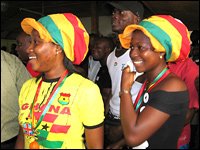
Will Ghana's Black Stars beat the no.1 team in the world, Brazil?
My heart says maybe, but my mind says there is no way.
NB: Why haven't Ghana been denounced by the UN and Ward Churchill because one of their players waives an Israeli flag in celebration?

Just another reason to pull for an upset.
Update: Not even close. Brazil 3-0, although I am told Ghana played well in the first half despite conceding two.
Sunday, June 25, 2006
Red Prairie Fire
Jay Bullock doesn't think much of Red Prairie CEO John Jazwiec and his view that Wisconsin's high taxes do not help attract, or keep, businesses here. Jay's post, following Xoff, seems to say that 1)Red prairie is obscure because Jay has never heard of them 2) Jazwiec is some kind of wing nut from California who thinks Wisconsin is socialist and 3) he and his bosses just want to poach a company (actually they bought it) that was built with Wisconsin smarts and Wisconsin labor - as if that means it must stay here forever.
Patrick McIlheran points out that, actually, Jazwiec is not much of a conservative.
The point is that taxes are not helpful in attracting business. It may be that there are other attributes of a place that outweigh taxes. Jazwiec points out, for example, that the concentration of good software companies in California makes it attractive even though its taxes - and cost of living - are high.
But Waukesha is not the Silicon Valley. We can't afford to be the sixth highest tax state in the country. The Badger Left likes to think that we have something of value for all we send to Madison, but the brutal truth is that we don't. Wisconsin has nothing that a slew of low tax states don't have. Save for really sweet pensions for government retirees.
Patrick McIlheran points out that, actually, Jazwiec is not much of a conservative.
The point is that taxes are not helpful in attracting business. It may be that there are other attributes of a place that outweigh taxes. Jazwiec points out, for example, that the concentration of good software companies in California makes it attractive even though its taxes - and cost of living - are high.
But Waukesha is not the Silicon Valley. We can't afford to be the sixth highest tax state in the country. The Badger Left likes to think that we have something of value for all we send to Madison, but the brutal truth is that we don't. Wisconsin has nothing that a slew of low tax states don't have. Save for really sweet pensions for government retirees.
Voting Rights Confusion
Eugene Kane wants expiring provisions of the Voting Rights Act renewed. But why?.
Maybe he just wants bilingual ballots and it is true that the federal mandate that they be used in certain circumstances will expire. As I blogged recently, people on the left side of the playground will generally say that immigrants should assimilate, but anything that would reflect that expectation is treated like a reenactment of the Nuremberg Laws. (Interestingly enough, Sensenbrenner supports bilingual ballots. So much for the "racism" charge.)
Maybe he wants what calls "federal protections for certain states" that some critics of the Act object to. He doesn't tell us what those are, but he is referring to the Act's "preclearance" requirements. Certain jurisdictions, identified in 1965 on the basis of certain results in the 1964 presidential election, can't change election procedures without preclearance by the U.S. Justice Department. To obtain preclearance, these jurisdictions must demonstrate that the change does not have the purpose, and will not have the effect, of discriminating against minority voters.
The covered jurisdictions are largely in the south, but New York County is one of them. Although there it is possible for a jurisdiction to be removed from the list, they mostly are not. The idea that these jurisdictions should continue to be singled out for special treatment is a historical artifact.
It's not even true that, once preclearance expires, these jurisdictions will be free to discriminate against minority voters (as unlikely as the suggestion that, say, New York City or Atlanta would actually do so might be). This is because that part of the Voting Rights Act that prohibits discrimination in voting is permanent. And, even if it weren't, discrimination against minorities in voting would be unconstitutional.
There is a widespread and, as he rightly points out, completely false belief in the African-American community that their right to vote is about to expire. Kane seems to conclude by arguing that the whole thing should be extended for its symbolic effect. It won't "sit well" with blacks to let these provisions expired even though they don't do anything. Having dispelled the myth of imminent disenfranchisement of blacks, he seems to think that we ought to act as if it were true.
Maybe he just wants bilingual ballots and it is true that the federal mandate that they be used in certain circumstances will expire. As I blogged recently, people on the left side of the playground will generally say that immigrants should assimilate, but anything that would reflect that expectation is treated like a reenactment of the Nuremberg Laws. (Interestingly enough, Sensenbrenner supports bilingual ballots. So much for the "racism" charge.)
Maybe he wants what calls "federal protections for certain states" that some critics of the Act object to. He doesn't tell us what those are, but he is referring to the Act's "preclearance" requirements. Certain jurisdictions, identified in 1965 on the basis of certain results in the 1964 presidential election, can't change election procedures without preclearance by the U.S. Justice Department. To obtain preclearance, these jurisdictions must demonstrate that the change does not have the purpose, and will not have the effect, of discriminating against minority voters.
The covered jurisdictions are largely in the south, but New York County is one of them. Although there it is possible for a jurisdiction to be removed from the list, they mostly are not. The idea that these jurisdictions should continue to be singled out for special treatment is a historical artifact.
It's not even true that, once preclearance expires, these jurisdictions will be free to discriminate against minority voters (as unlikely as the suggestion that, say, New York City or Atlanta would actually do so might be). This is because that part of the Voting Rights Act that prohibits discrimination in voting is permanent. And, even if it weren't, discrimination against minorities in voting would be unconstitutional.
There is a widespread and, as he rightly points out, completely false belief in the African-American community that their right to vote is about to expire. Kane seems to conclude by arguing that the whole thing should be extended for its symbolic effect. It won't "sit well" with blacks to let these provisions expired even though they don't do anything. Having dispelled the myth of imminent disenfranchisement of blacks, he seems to think that we ought to act as if it were true.
Friday, June 23, 2006
A garbage statistic
Xoff cites an Economic Policy Institute study that purports to show that the "average" CEO makes almost 11 million dolllars while the average worker makes a little over $40,000.
This is - and there is no other way to put it - flat out false. The "average" CEO does not make 11 million dollars. That figure is the average of compensation paid to some very not average CEOS, i.e, those that head 350 huge corporations with median annual revenue of 7.6 billion. If you rise to the top of the heap and run an enterprise that large, you make a lot of money. Maybe too much money. Just like it if you make it to the NBA (something which, statistically, you have a better chance of doing), you'll make a lot of money.
The average guy or girl running the average business does not make that much. Heck, the average business doesn't even make that much.
This doesn't mean that there is not income inequality. Inequality is inevitable in an economy that rewards talent and initiative. Whether the degree of income inequality that we have is a good or bad thing is something that can be debated, The problem with these debates is that the left forgets that how the pie is divided is realated to how large it becomes. They simply assume the pie.
I too wonder about how much shareholders choose to pay certain CEOs. In recent years, as the study that the EPI relies on makes clear, 80% of CEO compensation has come to ne "at risk", i.e., based on results. If someone comes in and manages a business in a way that it makes a billion more than it did last year, how much should that person make? I don't know, but I suspect that the people in the best position to judge that are the people whose money it is, i.e., the shareholders.
This is - and there is no other way to put it - flat out false. The "average" CEO does not make 11 million dollars. That figure is the average of compensation paid to some very not average CEOS, i.e, those that head 350 huge corporations with median annual revenue of 7.6 billion. If you rise to the top of the heap and run an enterprise that large, you make a lot of money. Maybe too much money. Just like it if you make it to the NBA (something which, statistically, you have a better chance of doing), you'll make a lot of money.
The average guy or girl running the average business does not make that much. Heck, the average business doesn't even make that much.
This doesn't mean that there is not income inequality. Inequality is inevitable in an economy that rewards talent and initiative. Whether the degree of income inequality that we have is a good or bad thing is something that can be debated, The problem with these debates is that the left forgets that how the pie is divided is realated to how large it becomes. They simply assume the pie.
I too wonder about how much shareholders choose to pay certain CEOs. In recent years, as the study that the EPI relies on makes clear, 80% of CEO compensation has come to ne "at risk", i.e., based on results. If someone comes in and manages a business in a way that it makes a billion more than it did last year, how much should that person make? I don't know, but I suspect that the people in the best position to judge that are the people whose money it is, i.e., the shareholders.
Thursday, June 22, 2006
Shark and Shepherd on the Air
Assuming that I have recovered from our ignominious ouster from the World Cup, I will be on Eric Von's Backstory segment from 4:30 to 6:00. The topics may be the Lautenschlager-Falk race (who cares?), the county sales tax, the travails of Marc Marotta and the rep of Nan Hegarty. Guests will include lefty Robert Miranda, not-quite-as-lefty Jim Rowen, the lovely (but somewhat lefty)Faithe Colas and, playing the role of Truth, the not-very-lefty me.
Wednesday, June 21, 2006
Fighting over the ruins of Milwaukee County
Xoff and Seth Zlochota think it's somehow important that Scott Walker has decided to fully fund the County's pension obligations now that he is not running for governor. Let's assume they are right. He was acting like a politician.
What they don't deny is that the County has to take all that money - enough to triple what we spend on parks or enough to turn the bus lines into a cornucopia of mass transit-ty goodness - and send it to people who don't work for it anymore. What they don't deny is that people who were, until the yokels from Citizens for Responsible Government got done with them, the scions of the Democratic Party ( including union officials who had been feted at Democratic Party functions since I was a Democrat and Howie Mandel had hair), left Milwaukee County looking like Dresden after a night of B-52s and Lancasters.
To blame Walker for this is like blaming the New York Port Authority for not providing its tenants with space on 9/12.
What they don't deny is that the County has to take all that money - enough to triple what we spend on parks or enough to turn the bus lines into a cornucopia of mass transit-ty goodness - and send it to people who don't work for it anymore. What they don't deny is that people who were, until the yokels from Citizens for Responsible Government got done with them, the scions of the Democratic Party ( including union officials who had been feted at Democratic Party functions since I was a Democrat and Howie Mandel had hair), left Milwaukee County looking like Dresden after a night of B-52s and Lancasters.
To blame Walker for this is like blaming the New York Port Authority for not providing its tenants with space on 9/12.
More Episco-Drama
The Windsor Report invited the Episcopal Church "to effect a moratorium on the consecration of any candidate to the episcopate who is living in a same-gender union until some new consensus in the Anglican Communion emerges" (Windsor Report, paragraph 134).
Initially, the General Convention was going to do nothing and merely passed a resolution that said, essentially, talking about these things is good.
Then the outgoing Presiding Bishop, Frank Griswold, and the incoming PB, Katharine Jefferts Schori, apparently recognizing that the Anglican Communion was about to throw the ECUSA over the transom, went before an extraordinary joint session of the delegates (called by Griswold) and urged them to pass a resolution calling on Bishops and Standing Committees to "exercise restraint by not consenting to the consecration of any candidate to the episcopate whose manner of life presents a challenge to the wider church and will lead to further strains on communion." That resolution was passed.
Certain liberal Bishops are upset. They are apparently circulating a statement in opposition to the resolution. I do not know who is signing, but the signatories would presumably not be the Bishop of Milwaukee who has already banned the ordination of persons who are sexually active outside of marriage and who has said that the priests in his diocese may not bless same sex unions. At least one Bishop said that he will not be exercising the slightest restraint whatsover.
But the resolution itself may not be enough to satisfy the other member churches of the Anglican Communion. And conservative Bishops (again, a group not including the Bishop of Milwaukee) are not happy either.
All of this raises questions about how quickly traditional notions of sexual morality ought to be abolished and whether there really is a parallel between the civil rights movement and the gay rights movement. It raises questions of how and when you should compromise to remain in community.
Personally, I really don't mind gay bishops and same-sex blessings (which is an entirely different issue than gay marriage). But I do mind the other theological positions of those who are their strongest supporters. And feel more attuned to the other theological positions of those who oppose them.
Initially, the General Convention was going to do nothing and merely passed a resolution that said, essentially, talking about these things is good.
Then the outgoing Presiding Bishop, Frank Griswold, and the incoming PB, Katharine Jefferts Schori, apparently recognizing that the Anglican Communion was about to throw the ECUSA over the transom, went before an extraordinary joint session of the delegates (called by Griswold) and urged them to pass a resolution calling on Bishops and Standing Committees to "exercise restraint by not consenting to the consecration of any candidate to the episcopate whose manner of life presents a challenge to the wider church and will lead to further strains on communion." That resolution was passed.
Certain liberal Bishops are upset. They are apparently circulating a statement in opposition to the resolution. I do not know who is signing, but the signatories would presumably not be the Bishop of Milwaukee who has already banned the ordination of persons who are sexually active outside of marriage and who has said that the priests in his diocese may not bless same sex unions. At least one Bishop said that he will not be exercising the slightest restraint whatsover.
But the resolution itself may not be enough to satisfy the other member churches of the Anglican Communion. And conservative Bishops (again, a group not including the Bishop of Milwaukee) are not happy either.
All of this raises questions about how quickly traditional notions of sexual morality ought to be abolished and whether there really is a parallel between the civil rights movement and the gay rights movement. It raises questions of how and when you should compromise to remain in community.
Personally, I really don't mind gay bishops and same-sex blessings (which is an entirely different issue than gay marriage). But I do mind the other theological positions of those who are their strongest supporters. And feel more attuned to the other theological positions of those who oppose them.
A deep breath
A GOP press release is highlighting an e-mail which shows some level of involvement by Marc Marotta in the travel contract that, or so a jury found, was illegally awarded to Adelman Travel. (There was a particularly trenchant column on the verdict in Tuesday's Milwaukee Journal Sentinel.)
Dems (like Jay Bullock)argue that the GOP is overreaching because it doesn't show that Marotta did anything wrong and they're right. It doesn't.
The problem is that Marotta, probably unwisely, pronounced that no one at the upper reaches of the Doyle administration (like Marc) would have even had this on their radar screen. I'm not the Secretary of Administration for the state of Wisconsin but I know that even I cannot recall everything that has been brought to my attention or on which I may have commented. By issuing that type of denial, when it turns out that he did have some involvement with the contract, it looks like his early statement was an attempt to cover up.
Marc Marotta and I used to be law partners but I know him only casually. I have no special insight into his character, but I'd be shocked if he intentionally did something illegal. He has never struck me as that type of guy.
But he did sort of step into this one.
And it does seem likely - or so the jury thought - that someone in the Doyle administration found some way to let Georgia Thompson know they wanted Adelman.
I think it would be irresponsible to accuse any individual of criminal conduct, but it does not seem that Doyle was running a clean ship.
Dems (like Jay Bullock)argue that the GOP is overreaching because it doesn't show that Marotta did anything wrong and they're right. It doesn't.
The problem is that Marotta, probably unwisely, pronounced that no one at the upper reaches of the Doyle administration (like Marc) would have even had this on their radar screen. I'm not the Secretary of Administration for the state of Wisconsin but I know that even I cannot recall everything that has been brought to my attention or on which I may have commented. By issuing that type of denial, when it turns out that he did have some involvement with the contract, it looks like his early statement was an attempt to cover up.
Marc Marotta and I used to be law partners but I know him only casually. I have no special insight into his character, but I'd be shocked if he intentionally did something illegal. He has never struck me as that type of guy.
But he did sort of step into this one.
And it does seem likely - or so the jury thought - that someone in the Doyle administration found some way to let Georgia Thompson know they wanted Adelman.
I think it would be irresponsible to accuse any individual of criminal conduct, but it does not seem that Doyle was running a clean ship.
The county wise guys screwed up

In this morning's paper, we learn that the required taxpayer contribution to Milwaukee County's pension fund is three times the tax levy for the parks. In related news, we learned that both the City and County of Milwaukee continue to lose population.
Elliott points out that you need to hang on to taxpayers to continue collecting taxes. It's a shame that Ament and the public employee unions did not heed the advice of Christopher Moltisanti:
"When you're bleeding a guy you don't squeeze him dry right away. Contrarily, you let him do his bidding suavely. So you can bleed him next week and the week after ...."
Episcopalians Won't Affirm Jesus Christ
Yesterday, the House of Deputies at the General Convention of the Episcopal Church just killed the following resolution:
Resolved, the House of _____ concurring, That the 75th General Convention of the Episcopal Church declares its unchanging commitment to Jesus Christ as the Son of God, the only name by which any person may be saved (Article XVIII); and be it further
Resolved, That we acknowledge the solemn responsibility placed upon us to share Christ with all persons when we hear His words, "I am the Way, the Truth, and the Life. No-one comes to the Father except through me" (John 14:6); and be it further
Resolved, That we affirm that in Christ there is both the substitutionary essence of the Cross and the manifestation of GodÂ’s unlimited and unending love for all persons; and be it further
Resolved, That we renew our dedication to be faithful witnesses to all persons of the saving love of God perfectly and uniquely revealed in Jesus and upheld by the full testimony of Holy Scripture.
I am nonplussed. I appreciate that there are arguments against such a resolution that do not implicate belief in the statement, i.e., that a church body cannot vote on the truth (it simply is the truth) and that a church need not constantly reaffirm what it has always taught. Both arguments are weak in the context of the Episcopal Church in 2006. We have consented to the consecration of a gay Bishop to the scandal of the wider Anglican Communion. While we argue that to do so was consistent with creedal Christianity, our brothers and sisters in rest of the Communion (and many right here) aren't so sure. In the face of a clear demand from the rest of the Anglican Communion calling upon us to express regret for doing so, we refused and refused even to pronounce a moratorium on further such consecrations (and same-sex blessings) while dialogue continues.
Maybe justice required all that. But then we elected a Presiding Bishop who has dallied with the heretical Bishop John Shelby Spong. (That the new PB is a woman also disturbs many parts of the Communion, but doing so 1)doesn't raise theological issues that are nearly so difficult and 2)that battle is pretty much over in our church and, in this case, was won by the right side.)
In this context, some reaffirmation of our commitment to creedal Christianity was in order.
Well, the argument continues, we don't have to buy into substitutionary atonement as an explanation of the Cross. But we do ("for our sake he was crucified by Pontius Pilate")and, besides, the resolution also speaks to thecrucifixionn as a manifestation of God's love.
But, some say, it is presumptious, divisive and maybe even "hateful" to insist on the uniqueness of Christ. That is the point at which we really go off the rails. The resolution does not say that non-Christians are not saved (that would actually be outside mainstream Christian thought as pronounced by such "liberals" as Pope Benedict XVI and John Paul II and Karl Barth), but that God's revelation in Jesus Christ is unique. If we can't affirm that, then it is one sad day.
Resolved, the House of _____ concurring, That the 75th General Convention of the Episcopal Church declares its unchanging commitment to Jesus Christ as the Son of God, the only name by which any person may be saved (Article XVIII); and be it further
Resolved, That we acknowledge the solemn responsibility placed upon us to share Christ with all persons when we hear His words, "I am the Way, the Truth, and the Life. No-one comes to the Father except through me" (John 14:6); and be it further
Resolved, That we affirm that in Christ there is both the substitutionary essence of the Cross and the manifestation of GodÂ’s unlimited and unending love for all persons; and be it further
Resolved, That we renew our dedication to be faithful witnesses to all persons of the saving love of God perfectly and uniquely revealed in Jesus and upheld by the full testimony of Holy Scripture.
I am nonplussed. I appreciate that there are arguments against such a resolution that do not implicate belief in the statement, i.e., that a church body cannot vote on the truth (it simply is the truth) and that a church need not constantly reaffirm what it has always taught. Both arguments are weak in the context of the Episcopal Church in 2006. We have consented to the consecration of a gay Bishop to the scandal of the wider Anglican Communion. While we argue that to do so was consistent with creedal Christianity, our brothers and sisters in rest of the Communion (and many right here) aren't so sure. In the face of a clear demand from the rest of the Anglican Communion calling upon us to express regret for doing so, we refused and refused even to pronounce a moratorium on further such consecrations (and same-sex blessings) while dialogue continues.
Maybe justice required all that. But then we elected a Presiding Bishop who has dallied with the heretical Bishop John Shelby Spong. (That the new PB is a woman also disturbs many parts of the Communion, but doing so 1)doesn't raise theological issues that are nearly so difficult and 2)that battle is pretty much over in our church and, in this case, was won by the right side.)
In this context, some reaffirmation of our commitment to creedal Christianity was in order.
Well, the argument continues, we don't have to buy into substitutionary atonement as an explanation of the Cross. But we do ("for our sake he was crucified by Pontius Pilate")and, besides, the resolution also speaks to thecrucifixionn as a manifestation of God's love.
But, some say, it is presumptious, divisive and maybe even "hateful" to insist on the uniqueness of Christ. That is the point at which we really go off the rails. The resolution does not say that non-Christians are not saved (that would actually be outside mainstream Christian thought as pronounced by such "liberals" as Pope Benedict XVI and John Paul II and Karl Barth), but that God's revelation in Jesus Christ is unique. If we can't affirm that, then it is one sad day.
Subscribe to:
Posts (Atom)